What is SOC 2 Compliance? Demystifying Security and Compliance for Businesses
SOC 2 compliance has become a crucial benchmark for security and trust. Cyber security risks are at an all time high – one study found that 59% of organisations experienced a data breach caused by a third-party vendor. At the same time, businesses face growing regulatory compliance pressures as the cost of data breaches and scrutiny from regulators has never been higher.
Achieving SOC 2 compliance shows your stakeholders that you prioritise security, data privacy, and confidentiality. In an era of evolving cyber risks, it’s not just a compliance requirement but a strategic necessity for maintaining a strong security posture.
This guide will help you understand why your organisation should prioritise SOC 2 and how to go about achieving it.
Key Takeaways
- SOC 2 compliance is a recognised auditing standard that demonstrates your organisation’s commitment to safeguarding customer data through strong security, availability, confidentiality, processing integrity, and privacy controls.
- It’s not a certification, but an attestation – issued by an independent auditor – and is especially critical for service providers handling sensitive or personal data.
- SOC 2 Type I evaluates your controls at a point in time, while Type II tests their effectiveness over a 6–12 month period – giving clients confidence in your ongoing security posture.
- Achieving SOC 2 boosts customer trust, reduces security risks, and opens up business opportunities, especially in regulated sectors and B2B environments.
- A strategic approach including proper scoping, risk assessments, documentation, and continuous monitoring is essential, and many companies accelerate the journey with expert-led or managed compliance services.
What is SOC 2?
SOC 2 stands for System and Organisation Controls 2. It’s an auditing standard developed by the American Institute of CPAs (AICPA) to evaluate how well service organisations protect customer data.
SOC 2 sets out criteria for data security, integrity, and confidentiality and verifies through an independent audit whether your controls meet those criteria. By meeting SOC 2 compliance – through an independent audit – you offer customers and partners assurance that you have implemented strong security controls to safeguard their data.
How It Differs from Other Compliance Frameworks
- SOC 2 vs ISO 27001: SOC 2 is an attestation – an auditor’s report that opines on your controls – whereas ISO 27001 is a formal certification against an international standard
- SOC 2 vs GDPR: GDPR is a regulation law, focused specifically on personal data protection legally enforced across the EU, while SOC 2 is broader and voluntary, demonstrating industry best practices. However, achieving SOC 2 helps businesses align with GDPR compliance principles, particularly concerning data privacy and confidentiality
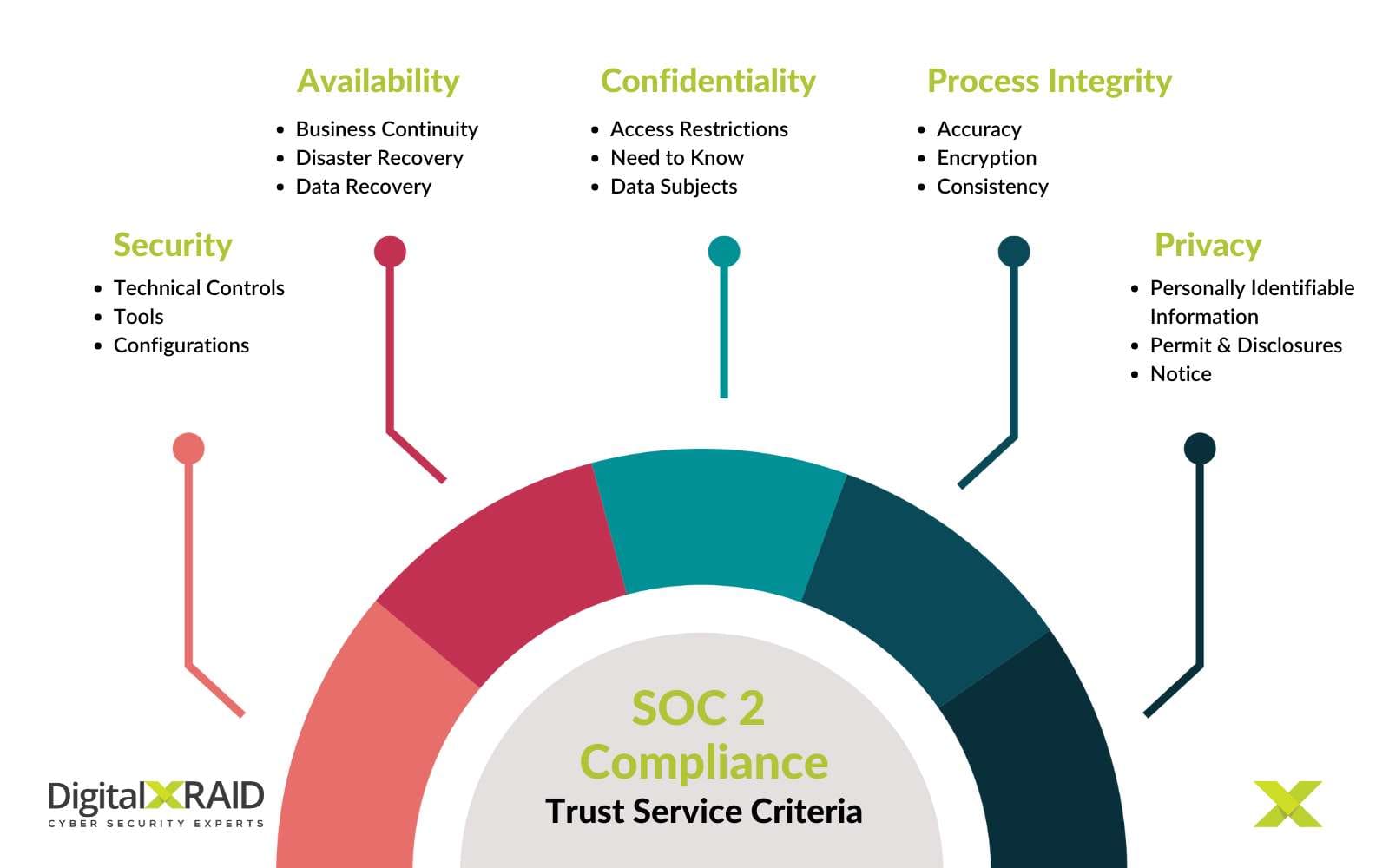
The Five Trust Service Criteria of SOC 2
At the heart of SOC 2 are the five Trust Service Criteria (TSC). These are the categories of controls that the framework evaluates. They collectively address the security, availability, processing integrity, confidentiality, and privacy of systems and data.
1. Security
Security is the foundation of SOC 2 and is the only mandatory criterion in every SOC 2 audit. It refers to the protection of system resources and data against unauthorised access or misuse.
The Security criterion evaluates whether you have controls in place to guard against breaches, data leaks, and other cyber threats. This includes everything from firewall configurations and access controls to intrusion detection, encryption, and incident response.
2. Availability
Availability focuses on ensuring that your systems and services remain running and accessible as needed. It’s about maintaining consistent performance and uptime so that customers can rely on your service.
In a SOC 2 context, Availability means you have controls for capacity planning, disaster recovery, and system monitoring to meet your commitments for availability. SOC 2 will also assess things like redundant infrastructure, backup power, failover systems, and incident response processes that keep your service available.
3. Processing Integrity
Processing Integrity is all about data processing being complete, accurate, timely, and authorised. This evaluates whether your systems process information correctly and reliably, avoiding errors or unauthorised manipulation.
According to the trust principles, processing integrity ensures that system processing achieves its intended purpose without introducing defects or data loss. If your service involves calculations, file transfers, or financial transactions this criterion is key.
4. Confidentiality
Confidentiality in SOC 2 is not just about personal data, it can include intellectual property, or any data that should be restricted.
The Confidentiality criterion evaluates whether you’ve limited access to confidential data to authorised staff and protected it from unauthorised disclosure. Key controls here include data encryption (in transit and at rest), access control lists, and data masking. During a SOC 2 audit, you’ll need to show that you have a defined process for identifying confidential data and implementing safeguards like user permissions, and encryption keys management to shield that data.
5. Privacy
Privacy is the trust criterion devoted to personal information (PII) and how it’s collected, used, retained, disclosed, and disposed of. It does align closely with privacy laws and regulations such as GDPR. It also covers how you share data with third parties, ensuring those parties have equal privacy protections and notifying users where required.
SOC 2 Compliance Checklist
Achieving SOC 2 compliance involves meeting a range of compliance requirements, from documenting processes to implementing technical controls. It’s useful to follow a SOC 2 compliance checklist outlining key phases and activities you should undertake:
Scoping
Clearly define which systems, processes, and data flows will be audited, focusing specifically on those impacting security, privacy, and confidentiality. Clearly scoping your audit ensures efficiency and completeness.
Involving an experienced auditor or compliance consultant early to clarify what should be in scope is advisable at this stage.
Risk Assessment
Identify potential vulnerabilities and threats that could affect compliance against each of the trust service criteria. By understanding your risk areas, you can prioritise which controls to implement or strengthen.
Documentation of your risk assessment process (methodology, findings, and mitigation plans) is also something auditors often review as part of SOC 2.
Control Implementation
Controls can be technical (firewalls, encryption, endpoint protection), physical (badge access to office areas or data centres), or administrative (policies, procedures, user training). Controls might include stronger password policies, encryption protocols, intrusion detection systems, and employee access management.
It’s important that controls are not just deployed but also functioning effectively. If you already align with frameworks such as ISO 27001 or NIST, you will already have a library of controls in place that generally map well to SOC 2 requirements.
Documentation
A crucial part of SOC 2 compliance is maintaining thorough documentation. Auditors will expect to see written policies, procedures, and records that demonstrate your controls are in place. Documentation should be comprehensive yet manageable, supporting continuous compliance.
Monitoring and Testing
SOC 2 requires ongoing monitoring and testing of your controls to identify vulnerabilities quickly, allowing for rapid remediation and ensuring controls function effectively all year round.
Auditors often ask for evidence of continuous monitoring, such as log review procedures or results of penetration tests. Demonstrating a habit of continuous compliance strengthens your case that you truly meet SOC 2 standards in your daily operations.
Employee Training
Ensure that all relevant staff are trained on SOC 2 best practices and their specific responsibilities in maintaining compliance. An educated and aware workforce is critical to actually fulfilling the promises of your SOC 2 controls.
Integrating SOC 2 topics into your onboarding and annual training programs will help build a security conscious culture in your organisation. Keeping records of training sessions or completion of policy read throughs can serve as evidence.
Engaging an Auditor
SOC 2 compliance requires a formal audit by an independent CPA (Certified Public Accountant) firm or an accredited assessor. Engaging an auditor early in the process can be beneficial.
If you’re new to SOC 2, you might opt for a Type I audit first (which evaluates design of controls at a point in time) before undertaking the more involved Type II audit (which tests operating effectiveness over a period of 6-12 months).
Remediation
Remediation is important not just for passing the audit but for genuinely improving your security. In a Type I audit, any gaps will be noted in the report’s description. In a Type II audit, control failures during the period could lead to exceptions in the report. You will have a chance to correct issues and possibly undergo additional testing if needed.
Common remediation steps include developing missing policies and getting them approved, tightening configurations on systems, providing additional staff training, or enhancing monitoring.
Who Needs SOC 2 Compliance?
If you provide services that involve customer data, especially in a B2B context, SOC 2 compliance is either required or highly beneficial.
Service Organisations
SOC 2 was designed for service organisations. This includes a broad range of industries and company types, such as SaaS providers, cloud computing companies, data centres, managed IT service firms, payment processors, and more.
If your business offers a technology platform or outsourced service where clients entrust you with their information, you are a prime candidate for SOC 2.
Regulatory Requirements
While SOC 2 itself is not dictated by law or regulation, certain industries and clients have made it an expected standard.
Banks and fintech companies often look for SOC 2 reports from their tech vendors as part of due diligence.
In the healthcare space, organisations may already comply with HIPAA for patient information. Adding SOC 2 can cover additional security aspects not detailed in HIPAA and provide a competitive differentiator for service providers in that field.
Government contracts sometimes require security attestations that SOC 2 can satisfy. In terms of general contractual obligations, larger enterprises frequently mandate their vendors to provide a SOC 2 report as part of the contract.
Market Differentiation
There’s a strategic competitive advantage from aligning to the SOC 2 framework. It signals to prospective clients that you’re serious about security and have been vetted by an independent auditor.
Market differentiation through SOC 2 can also open doors to new industries or bigger clients that previously might have been unreachable due to stringent security requirements.

SOC 2 vs. ISO 27001
If you’re assessing different security frameworks, two big names that might come up are SOC 2 and ISO 27001. Both aim to improve and demonstrate your security, but they have distinct approaches:
Scope and Focus
SOC 2 and ISO 27001 differ in scope. SOC 2 is scoped to the specific services and systems that you decide are relevant within the five Trust Service Criteria. It’s focused on the operational effectiveness of controls for protecting customer data in those systems, and you tailor it to your environment. ISO 27001 certification has an enterprise wide scope by establishing an Information Security Management System (ISMS).
There’s a lot of overlap. For example, both will care that you control access to data, and both will care that you manage risks.
Certification vs. Attestation
One of the most important distinctions is that SOC 2 is an attestation, while ISO 27001 is a certification. This means the end result of a SOC 2 audit is an attestation report stating opinion on the design and effectiveness of your controls.
ISO 27001 results in a certificate issued by an accredited certification body, which states compliance with the ISO standard. You can publicly claim you are ISO 27001 certified and even display the certificate.
Geographical Recognition
ISO 27001 is internationally recognised. If your business operates in multiple regions or you have a diverse client base worldwide, ISO 27001 certification might carry more weight. In Europe, many companies will ask about ISO 27001 certification as a baseline for vendors. SOC 2 is most popular in North America, particularly the United States.
Implementation Effort
ISO 27001 is generally considered more demanding to implement and maintain. It requires setting up an ISMS, which means formalising risk management processes, getting leadership buy in, establishing documentation, and continually improving the system. It often takes months to prepare for ISO 27001: conducting a risk assessment, defining a risk treatment plan, and implementing Annex A controls or justifying why they’re not needed.
SOC 2 can be more agile. You only need to focus on the controls for your scoped systems. For SOC 2 you might have to implement new software for logging or monitoring, tighten up a lot of operational processes, and run them for several months to collect evidence for a Type II audit.
SOC 2 Type I can be done in a few months and Type II in 6–12 months of evidence collection, but Automated compliance tooling and expert services can significantly reduce this time.
Cost wise, ISO 27001 can be more expensive due to the longer preparation, multiple audit stages, and the need to involve more of the organisation in the ISMS.

Benefits of SOC 2 Compliance
SOC 2 compliance offers a significant return on investment in trust, competitive positioning, risk reduction, and compliance readiness.
Enhanced Trust
A SOC 2 report essentially serves as a 3rd party validation of your security controls. When you present this attestation to customers, it instils confidence that you are protecting their data in line with industry best practices. SOC 2 compliance often improves trust with partners.
Competitive Advantage
Having SOC 2 compliance gives you a clear competitive advantage in many B2B procurement processes. Businesses with SOC 2 compliance in place often close deals faster by easily demonstrating robust security.
Risk Mitigation
The process of working toward SOC 2 forces you to strengthen your controls and address security weaknesses. By conducting regular SOC 2 audits (annual or continuous monitoring), your organisation will identify and fix vulnerabilities proactively, which reduces the likelihood of data breaches, service outages, or other incidents.
Being SOC 2 compliant might favourably impact your cyber insurance or reduce the scope of customer security audits, which can save resources.
Regulatory Alignment
While SOC 2 is voluntary, achieving compliance often puts you in a good position relative to various laws and regulations. Many SOC 2 controls overlap with requirements in frameworks like ISO, HIPAA, GDPR, and others that might affect your business.
By implementing SOC 2’s trust criteria, you inherently address aspects of data protection that regulators care about. Security controls like access management, encryption, and monitoring are required by multiple regulations.
Steps to Achieve SOC 2 Compliance
Achieving SOC 2 compliance can be broken down into a series of steps or phases:
Preparation
SOC 2 preparation involves understanding requirements, assessing your current state, educating your team, defining the audit scope and trust criteria, and conducting a gap analysis.
Many companies use consultants or compliance software for guidance. Defining the audit type (Type I vs Type II) is crucial as it impacts your timeline.
Implementation
During the implementation phase, you’ll deploy security controls, create documentation, and train staff. Prioritise controls that address the biggest risks and collect artifacts (like system logs and policy documents). Some changes might be quick wins like turning on encryption settings, while others might require significant shifts in processes.
Audit
The Audit phase is when an independent auditor evaluates your environment – validating that your description of the system and controls is accurate and meets the criteria. In a Type I audit, they will check that controls are designed appropriately and may do a light test of one instance of each control. If it’s a Type II audit, the auditor will test evidence that the controls operated continuously or at multiple intervals during that period.
Reporting
The final step is reporting and leveraging your SOC 2 compliance. If your report includes exceptions or recommendations, build those into your maintenance plan going forward.
SOC 2 reports are usually confidential, so you might need to share them under NDA. Internally, you should report the success to your leadership and staff as achieving SOC 2 is a big accomplishment that takes team effort. Externally, you might announce that you’ve achieved SOC 2 compliance, as part of your marketing communications.

Challenges in Achieving SOC 2 Compliance
Before embarking on SOC 2, be prepared for challenges so you can navigate them more effectively:
Resource Allocation
For small and mid-sized companies without dedicated compliance teams, SOC 2 efforts add to existing workloads. Costs include new tools, auditors, and consultants, so securing leadership buy-in early is key. Phasing the project – starting with Type I – can help manage resources. External experts or automation tools can lighten the load, but internal teams must still contribute.
Complexity of Controls
SOC 2, especially Security, involves numerous complex controls. Translating abstract criteria into actionable steps may require expert input to avoid over- or under-engineering solutions. Following established frameworks like NIST can help. Once implemented, maintaining controls becomes routine, though the initial setup is the hardest part.
Continuous Monitoring
SOC 2 requires ongoing monitoring, documentation updates, and regular reviews, which can be difficult with staff turnover, system changes, and evolving threats. Building these tasks into your operations prevents compliance gaps, especially as SOC 2 criteria evolve.

Strengthening Business Security with SOC 2 Compliance
Achieving SOC 2 compliance is a significant milestone that signals your business’s commitment to security and trust. By going through this journey, you’ll likely improve your security posture dramatically, making your systems safer, your processes tighter, and your team more security aware.
Consider where your biggest gaps are and what benefits SOC 2 could bring. Each year, threats evolve and so do expectations from customers and regulators. SOC 2 gives you a framework to stay ahead of the curve through continuous improvement.
Ready to take the next step? If you want expert guidance on navigating the SOC 2 journey or need help maintaining your SOC 2 compliance, consider leveraging specialised professional services.
Contact us today to see how DigitalXRAID’s SOC 2 Compliance Service can assist you in assessing your current state, implementing best-practice controls, and preparing for a successful audit. Our experts will help you streamline the process and ensure you get it right the first time.