From Detection to Action: A Guide to Identifying and Responding to Cyber Threats
Cyber threat detection is a constant game of catch-up. As the methods used by cyber-criminals become more sophisticated, so do the methods and tools used by those who fight them. It’s unlikely the game will ever end. As long as there’s a digital landscape to operate in, criminals will pose a threat to systems relying on it.
The growing sophistication and diversity of cyber threats affects almost every business. A recent report found 75% of 1400 organisations surveyed suffered a ransomware attack. As reported by the BBC in May 2024, the ICO says ransomware incidents increased by 170% between 2022 and 2023 alone.
Everyday phishing has also evolved, splitting into cleverly-targeted Spear phishing aimed at individuals and groups, Whaling attacks sent to senior executives, Smishing attacks via SMS, and increasingly convincing Vishing attacks over the phone. Between the launch of ChatGPT in late 2022 and May 2024 there was a 4151% increase in malicious phishing. There has also been a reported 341% increase in malicious phishing links, business email compromise, QR code, and attachment threats, as well as an 856% increase in malicious email and messaging threats.
DDoS attacks, which flood systems with internet traffic so they can’t operate properly, are also becoming an issue. While DDoS attacks are becoming less frequent they are getting more powerful, focusing on crippling vital infrastructure and increasingly being used to disrupt and extort organisations. With HTTPS floods and DNS amplification surging in popularity, DDoS threats are becoming ever-more complex.
This is just the tip of the cyber-threat iceberg. It means robust detection and response strategies are critical to organisations of every kind, from charities to Blue Chips, as well as start-ups to SMEs.
The real world impact of successful attacks can be business-changing. If your threat detection and response mechanisms aren’t strong enough, you could be fined a fortune for data breaches, have your system infiltrated, your brand reputation damaged, and your customers sent fleeing somewhere safer.
Key Takeaways
- Cyber threats are evolving rapidly, with phishing variants, ransomware, and DDoS attacks increasing in both frequency and sophistication.
- Effective cyber threat detection requires real-time monitoring, threat intelligence, and advanced analysis techniques like packet inspection, log analysis, and sandboxing.
- The TDIR (Threat Detection, Investigation, and Response) model ensures structured, effective response to incidents, supported by triage, containment, eradication, and recovery.
- Automation and platforms like SOAR and IRPs enhance response speed and accuracy, enabling 24/7 coverage and reducing analyst fatigue.
- Continuous improvement, employee training, and threat intelligence sharing are critical for staying ahead of attackers and building long-term cyber resilience.
Understanding Cyber Threat Detection
Cyber threat detection is the process used to identify malicious activities and spot suspicious anomalies in IT systems and networks. Because threats happen in real time, real time monitoring is essential to stop them before they become nightmares. It’s a complex task involving managed security, including things like threat intelligence feeds, behavioural analysis, cloud penetration testing, and signature-based detection methods. As you can imagine it’s an expert task. Sadly, because there’s a serious skills shortage in cyber security, finding a suitable in-house hire can be challenging as well as expensive.

Key Steps in Identifying Cyber Threats
So what are the key steps and techniques behind cyber threat identification? For a start there’s network packet analysis, also called packet sniffing and packet capturing, which involves looking at the contents of packets of data transmitted over the internet to spot safety issues before they can cause harm.
Log file monitoring or log monitoring involves analysing log file data created by apps, systems, and devices to find anomalies that reveal cybersecurity problems.
Sandboxing for malware analysis is a way to run, observe, and analyse data in a safe, isolated environment on a network that mimics the real thing, used to stop threats getting onto networks in the first place.
Numerous threat hunting exercises proactively search for cyber threats lurking undetected in networks, and delve deep to find malicious actors that have made it past your endpoint security defences.
Common cyber threat indicators include unusual network traffic patterns, suspicious login attempts, unauthorised file access, and unexpected system behaviour. The use of unapproved personal electronic devices for business can be a sign there’s mischief afoot, as can unusual requests for authorisation to access systems. Suspicious logins and site access at unexpected times of day or night hints something might not be right, as do surges in traffic hinting at data downloads and transfers, and odd patterns in access to sensitive documents or data.
Responding to Cyber Threats Effectively
An effective cyber threat response is staged logically using the threat detection, investigation, and response process or TDIR. It involves finding, analysing, and mitigating threats using constant system and network monitoring to identify malicious activity and potential vulnerabilities.
Investigating the threats detected involves detailed analysis to understand what they are, where they came from, and how they might impact your systems. Then, experts take action to neutralise the threat, repair the damage, and do what’s necessary to make sure it doesn’t happen again.
Covering cyber threat triage, containment, eradication, recovery, and finally an analysis, incident response best practices involve setting up a designated incident response team, clearly defining the response roles and responsibilities, and creating lifelike incident response scenarios to help pin down how to react to threats if they happen.

Leveraging Technology for Cyber Threat Response
Clearly it’s a 24/7/365 task, far too much for one human to handle, which is why cybersecurity technologies and services play such a vital role. They cleverly automate threat detection and response processes, reducing response times for SOC analysts and helping prevent human error.
A variety of tools and tech streamline the cyber threat response workflow. Integrated threat intelligence platforms collect, aggregate, and organise threat intelligence from multiple sources, in a variety of formats, so they’re easier to see, explore, and analyse. SOAR, or security orchestration, automation and response, integrates different technologies to connect security-specific and non-security specific tools so they work together to improve incident response. It helps organisations resolve incidents more efficiently, cut the costs, and plug any security gaps.
Incident response platforms, or IRPs, streamline cyber threat response workflows to support human experts, automate repetitive tasks, allow threat detection and response, and provide 24/7/365 defence.

Continuous Improvement and Lessons Learned
Because cyber threats are constantly evolving, cyber threat detection isn’t just one destination. As cyber threats morph and change, so do the systems and methods designed to deal with them. The same goes for response and mitigation.
Effective digital security means continuous improvement in cyber threat detection and response capabilities via regular ongoing training, tabletop exercises, red team-blue team simulations, and incident post mortems.
It’s also a community process. There’s a great deal of value in sharing threat intelligence and information with industry communities via non-profit ISACs. These are trusted organisations dedicated to information sharing and best practices, created to improve everyone’s collective cyber resilience.
Proactive Cybersecurity for Resilient Operations
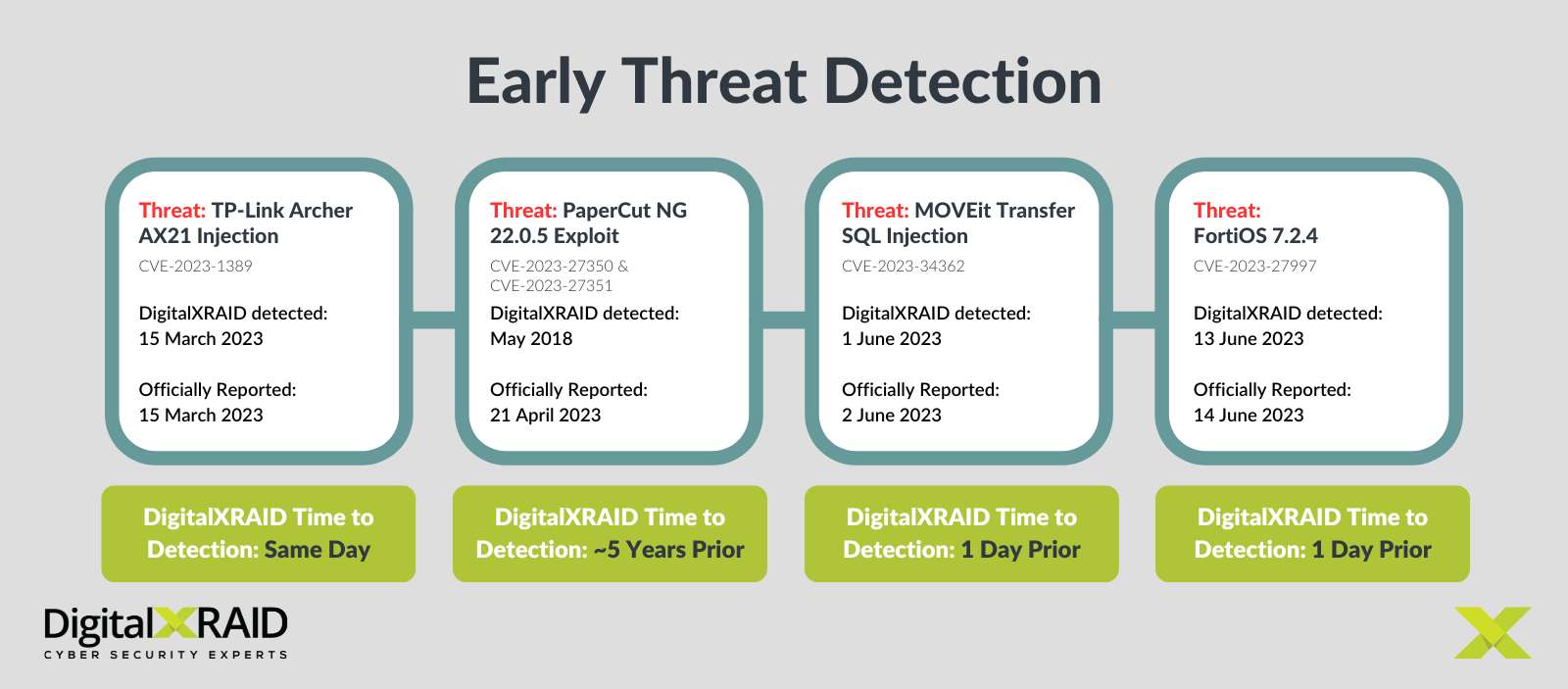
The key principles of proactive cybersecurity include threat anticipation, early threat detection, fast response, and continuous improvement. It’s about being vigilant and adopting a proactive mindset towards cyber threats that every employee understands and implements. It involves investing in cybersecurity technologies, engaging in threat intelligence sharing, and putting cybersecurity awareness and training top of the list across every aspect of your organisation.
Most of the time, only the biggest organisations can afford a dedicated IT security team and, as we’ve mentioned, the current skills shortage means there often are not enough experts to go round. That’s why external cyber threat detection expertise is often the best way ahead.

To find out more about how DigitalXRAID can help your business identify and respond to cyber threats effectively, get in touch or call us on 0800 090 3734.